Long Read9 min read
Three Sets or Twenty? Productive Volume vs Junk Volume
Three hard sets can be enough. Twenty can be enough too. Learn the difference between productive, recoverable, and junk volume, and how to find the dose that keeps you progressing.

Three hard sets can be enough. Twenty can be enough too. Learn the difference between productive, recoverable, and junk volume, and how to find the dose that keeps you progressing.
Search for how many sets per muscle per week and you will quickly find a familiar range. (We broke down why the standard weekly set counts keep failing separately; this article is about what makes those sets count.) Ten sets. Fifteen sets. Twenty sets. Sometimes the number is presented as a minimum. Sometimes it is presented as an optimal target. Sometimes it is presented with enough certainty to make every lifter who trains outside that range feel as if they are doing something wrong.
The problem is not that these numbers are useless. A range can be a helpful place to begin. The problem is what happens when a starting point becomes a rule.
Some lifters grow and get stronger from a small amount of very hard, carefully selected work. Three demanding sets may be enough to create progress when the lifter performs them well, recovers from them, and can improve them over time. Other lifters need more total work. They may benefit from additional sets, more frequent practice, or a larger amount of recoverable volume before their performance and physique begin to move.
Both situations can be real.
The best training volume is not the number that sounds most scientific. It is the dose that produces a useful signal in your body and your training history.
Why the Internet Loves One Number
Training volume is attractive because it looks measurable. Sets are easy to count. A weekly target is easy to write down. A coach can give you a number, a lifter can compare their number with someone else’s, and a study can be summarized into a sentence that sounds actionable.
That simplicity is part of the appeal.
If someone tells you to perform twelve sets for chest each week, the instruction feels clear. You know what to do on Monday. You know what to do on Thursday. You can write the number into a program and feel that the important variable has been handled.
But a set is not a complete description of training stress. Ten sets can mean ten controlled, challenging sets performed with stable technique and enough recovery to improve. It can also mean ten rushed sets, performed after poor sleep, with inconsistent exercise selection, unclear effort, and no meaningful progression.
The count is the same. The training is not.
This is why a universal number can be useful as a starting hypothesis but dangerous as a permanent prescription. It gives you somewhere to begin. It cannot tell you where you should stay.
What Does a Set Actually Represent?
When lifters talk about sets per muscle, they are often counting work as if every set contributes the same amount. In practice, the value of a set depends on several factors:
- How close the set was to failure
- Whether technique kept the target muscle under meaningful tension
- The exercise being used (see how to choose the best exercise for each muscle)
- The number of repetitions and the load
- How much fatigue was already present
- Whether the set overlapped with work for another muscle group
- Whether the lifter can recover and repeat the performance
A hard set of a stable machine exercise is not identical to a technically unstable set performed at the end of a long session. A set of bench press may contribute to chest, front delts, and triceps, but not necessarily in the same proportion for every lifter. A set of rows may train the back while also placing different demands on the biceps and rear delts depending on technique and exercise selection.
Counting is still valuable. It gives you a language for comparing work. But counting is not the same as understanding the work.
The important question is not only, “How many sets did I complete?” It is also, “What did those sets produce?”
Form Is Part of the Stimulus
Volume only means something when the work is performed with enough efficiency to create the intended stimulus.
This does not mean every repetition has to look identical or that training must be perfectly slow and controlled. Hard sets naturally become more difficult. Repetitions may slow down. Small adjustments may appear as fatigue rises. But if the target muscle loses its role completely, the number of sets on paper can start to overstate the value of the training.
A set of lateral raises that turns into a full-body swing is not the same stimulus as a set where the delts remain meaningfully involved. A rowing movement that becomes a shortened lower-back movement may still be difficult, but the difficulty is no longer distributed in the way the lifter intended. A squat that loses position and becomes an uncontrolled survival effort may create fatigue without creating the same quality of leg stimulus.
When form becomes inefficient, additional sets may produce only minimal extra gains while continuing to add fatigue. The lifter may believe they need more volume when the real problem is that the existing volume is no longer being directed effectively.
There is also a place for deliberately exceeding the normal limit of a set. Forced repetitions, assisted repetitions, rest-pause work, drop sets, and controlled partial repetitions can all be useful tools when applied with a clear purpose. For example, partials performed after full-range repetitions may extend a set when the lifter has already reached the point where complete repetitions are no longer possible. A training partner may help with a small number of forced repetitions. These techniques can create a strong stimulus, but they also increase fatigue and should not be treated as free volume.
The distinction is intent. Losing form because the set was not planned is different from choosing a controlled technique to push beyond the normal limit after the most productive full-range repetitions are complete.
Good form is not about making every set easy. It is about making the difficulty count.
Progressive Overload Is the Point
Volume is only one possible way to create progression (for the full picture, see what progressive overload should actually track). The purpose of tracking sets is not to collect a larger number forever. It is to understand whether the training stimulus is improving.
Progressive overload does not have to mean adding weight every session. Progress can come from:
- More repetitions with the same load
- More load for the same repetitions (which to increase first depends on what changed)
- An additional productive set
- Greater effort or closer proximity to failure
- Better range of motion
- Cleaner, more stable technique
- More control during the eccentric or difficult part of the movement
- More work completed in the same amount of time
- The same performance with less fatigue
These forms of progress are not identical, and they should not be forced into one score. A heavier weight is useful when the movement remains effective. An extra repetition is useful when it is performed with comparable technique. An additional set is useful when it creates more productive work without damaging the next session. Greater intensity is useful when the lifter can recover from the increased demand.
This is why a workout log needs more context than a list of weights. If the load has not changed but repetitions, execution, range of motion, density, or consistency have improved, the training may still be moving forward.
Progressive overload is not the command to make every variable harder at once. It is the practice of gradually asking the body to do more, do it better, or tolerate the same work with less cost.
The goal is not to chase numbers for their own sake. The goal is to create a progression the body can actually adapt to.
Intensity and Longevity Are Different Things
One of the most common mistakes in this conversation is treating intense training and long-term progress as opposites.
They are not.
Intensity describes the demand of the work. Longevity describes whether you can continue training productively across months and years. A lifter can train with very high effort and still build a long, sustainable training career if the total workload is managed intelligently.
The issue is not that hard training is automatically destructive. The issue is that hard training has a cost, and that cost must be included in the plan.
Three intense sets may be enough for one lifter because those sets are highly focused, technically consistent, and recoverable. That lifter may be able to repeat the work, add a rep, improve the load, or execute the movement better the next time. For them, adding seven more sets because an online chart says they need ten may reduce performance rather than improve it.
Another lifter may perform three sets and still have plenty of capacity left. Their technique may remain strong, their performance may be stable, and their target muscles may need more total work to create a useful stimulus. Adding volume may be the right decision for that person.
High effort is not the enemy of longevity. Unmanaged fatigue is.
The History of Volume Keeps Changing
Training history has never settled on one permanent answer.
Some bodybuilding systems became associated with high volume: many exercises, many sets, multiple angles, and long sessions. The logic was straightforward. If training creates a stimulus, more training might create more stimulus.
Other systems challenged that assumption. High-intensity approaches asked whether lifters were doing more work than they could recover from and whether fewer sets performed with greater effort might be enough.
Modern training added more language to the discussion: effective sets, proximity to failure, weekly volume, frequency, minimum effective volume, maximum recoverable volume, and periodization. The vocabulary became more precise, but the individual question remained.
What works for this lifter, with this exercise selection, at this stage of training, inside this week, with this recovery capacity?
The lesson from history is not that one era was correct and another was mistaken. It is that different systems can work under different conditions. A system becomes useful, as with choosing the best workout program, when it creates progress for the person running it—not when it wins an argument about the correct number of sets.
Periodization: The Dose Does Not Have to Stay the Same
Training volume is not required to remain constant forever.
Periodization exists partly because the body and the goals of training change over time. A lifter may use a higher-volume phase to accumulate work, a heavier phase to emphasize strength, a lower-volume phase to reduce fatigue, and a deload when performance and recovery need more space.
That does not mean every program needs to be complicated. It means training stress can be organized instead of repeated blindly.
A productive training year may include:
- Periods with more total work
- Periods with heavier loads and fewer repetitions
- Periods with higher effort but fewer sets
- Exercise changes that reduce joint stress or address a weakness
- Easier weeks that allow fatigue to dissipate
- Transitions based on performance rather than an arbitrary calendar
The point of periodization is not to avoid intensity. It is to make intensity and volume fit inside a longer process.
A lifter who can push hard, reduce fatigue when necessary, and return to productive work has a better chance of progressing for years than a lifter who treats every week as a test of how much punishment they can tolerate.
Three Sets Can Be Enough. More Sets Can Also Be Enough.
It is tempting to replace one universal rule with another. If ten to twenty sets is too broad, perhaps the answer is to tell everyone to train with three intense sets.
That would make the same mistake in a different direction.
Three high-quality sets can be enough when they create a strong stimulus and the lifter continues to improve. The evidence is visible in the training: more repetitions with the same load, more load for the same repetitions, better execution, stronger repeated sets, improved work capacity, or a clear positive change in the target muscle over time.
But three sets are not automatically enough simply because they are intense. If performance is stagnant, the target muscle is receiving too little practice, or the lifter finishes every session with plenty of capacity and no sign of progress, more work may be appropriate.
More volume is not automatically better either. If additional sets make performance worse, recovery slower, joints more irritated, and consistency less reliable, the extra work may be creating fatigue without creating a proportionate benefit.
There is no contradiction here. The dose is individual.
The right question is not, “Are three sets enough for everyone?” It is, “Are the sets I am doing producing progress that I can repeat?”
Productive Volume, Recoverable Volume, and Junk Volume
The word volume can hide three different ideas.
Productive volume is work that contributes to a meaningful training outcome. It may improve strength, muscle growth, technique, work capacity, or the ability to repeat a movement with better control.
Recoverable volume is the amount of work you can absorb while still performing well in future sessions. It is not necessarily the maximum amount you can survive once. It is the amount you can repeat and improve with.
Junk volume is work that adds fatigue without adding enough useful stimulus to justify its cost. The boundary is not identical for every lifter. A set that is unnecessary for one person may be valuable practice or productive stimulus for another.
This is why the phrase “more volume” is incomplete. More than what? More than last week? More than your current recovery can support? More than you need to progress? More than you can perform with stable technique?
The target is not maximum work. The target is enough useful work to keep the progression signal moving.
How Do You Know Whether Your Volume Is Working?
The only reliable way to judge volume is to watch the response over time.
One workout is rarely enough. A good session can be followed by a poor one. A difficult week can be followed by a breakthrough. The signal becomes clearer when you compare repeated training across several weeks.
Useful signs include:
- More weight for the same repetitions
- More repetitions with the same weight
- Better technique at the same load
- Stronger performance across repeated sets
- Improved estimated strength or personal records
- More work completed without a loss of quality
- Stable performance despite normal changes in sleep or stress
- Better consistency from session to session
- Positive changes in the target muscle over time
There are also warning signs:
- Performance declines for several sessions
- Repetitions or load fall despite consistent effort
- Technique becomes less stable
- Joint irritation continues to increase
- Motivation and consistency collapse
- The next session is repeatedly compromised by the previous one
- More sets are being added without any measurable improvement
None of these signals should be interpreted in isolation. A bad week does not prove that your volume is too high. A single personal record does not prove that your program is perfect. Training is a pattern, and the pattern needs enough history to become readable.
When Should You Add or Reduce Volume?
Adding volume can make sense when performance is stable, recovery is good, execution remains strong, and the current workload has stopped producing progress. The increase does not need to be dramatic. One additional set for a muscle group, another weekly exposure, or a small increase in useful work may be enough to test the next dose.
Reducing volume can make sense when performance is falling, fatigue is accumulating, joints are becoming irritated, or the work is interfering with the next session. Reducing volume is not giving up. It can be a way to preserve intensity, restore quality, and create room for progress to resume.
The mistake is making either change emotionally. Lifters often add sets because they are worried that they are not doing enough, then reduce everything because they cannot recover from the panic-driven increase. A better approach is to make one change, observe the response, and keep enough consistency to understand what happened.
The adjustment should be based on evidence, not guilt.
Why Your Workout Log Matters
Volume is difficult to manage when you cannot remember what you did.
A workout log gives each session a reference point. It can show the previous weight, the previous repetitions, the number of completed sets, and whether the same work is moving forward or quietly declining. It can reveal that one muscle group is receiving far more attention than another. It can show whether added volume produced progress or only added fatigue.
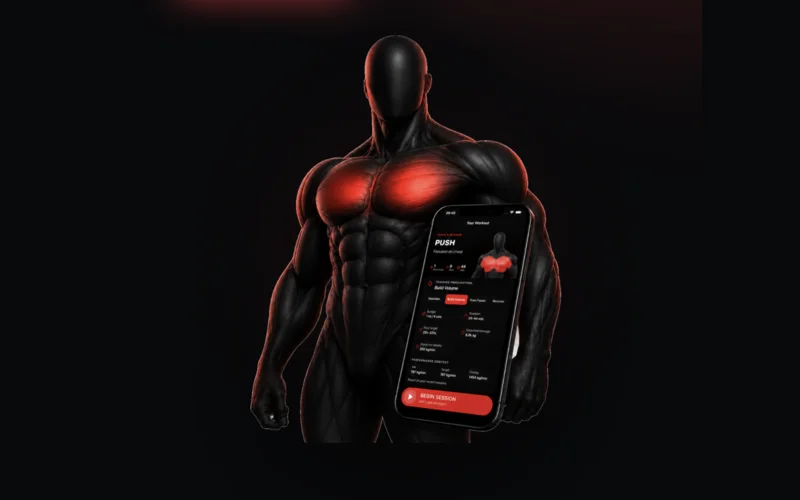
This is where an app can become more useful than a simple list of exercises. The purpose is not to turn training into a spreadsheet. The purpose is to keep the feedback loop visible while you are training.
NEX helps lifters see the signals behind their sessions:
- Previous performance before the next set
- Weight, repetitions, and completed sets
- Personal records and strength trends
- Training volume over time
- Muscle-group workload and distribution
- Training intensity and effort patterns
- Session density and work capacity
- Consistency across weeks
- Signs that performance is improving, stalling, or declining
NEX does not need to tell every lifter that the answer is three sets, ten sets, or twenty sets. It can help you discover whether the amount of work you are doing is producing progress for you.
Train. Measure. Adjust. Repeat.
The Real Answer
So how many sets per muscle should you perform each week?
The honest answer is that a useful range can help you begin, but your training history has to decide what comes next.
Three intense sets may be enough if you can perform them well, recover from them, repeat them, and continue progressing. More volume may be better for another lifter if the additional work is productive, recoverable, and measurable. Neither approach is automatically superior. The answer depends on the individual, the goal, the exercise selection, the training age, the recovery capacity, and the phase of training.
Intensity and longevity are not opposites. You can train hard and train for a long time when you manage fatigue and organize the work across time. Periodization helps you change the dose when the goal, the phase, or the feedback changes.
There is no glove that fits every lifter.
The best training volume is the amount of productive work you can perform, recover from, repeat, and progress with.
Do not chase the perfect number.
Keep the signal visible.
More from NEX Insights