Long Read11 min read
What Is the Best Exercise for Each Muscle Group—and How Do You Know It Is Right for You?
There is rarely one universally best exercise for a muscle group. Learn how to choose movements that fit your goal, body, equipment, and progression path.
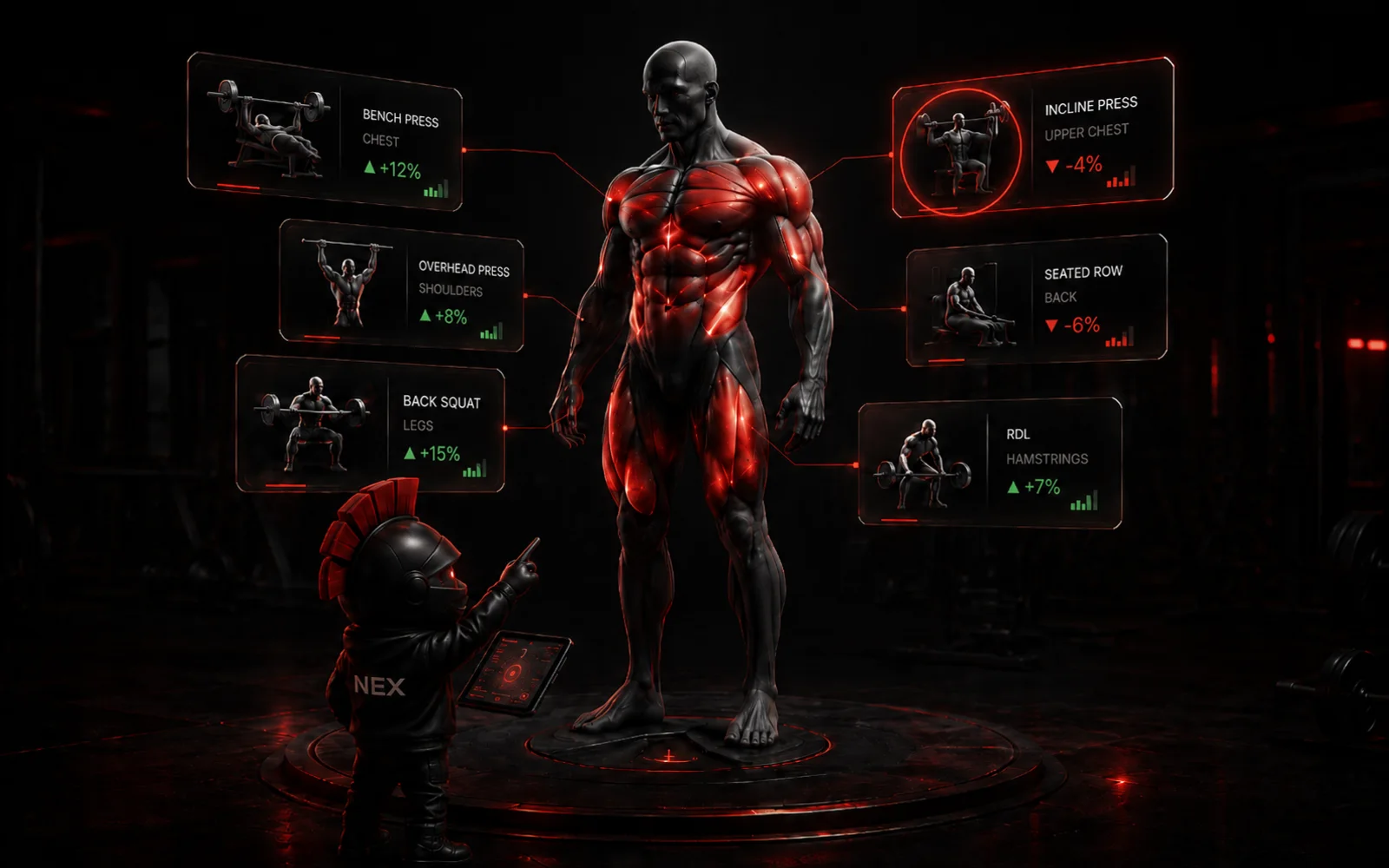
There is rarely one universally best exercise for a muscle group. Learn how to choose movements that fit your goal, body, equipment, and progression path.
# What Is the Best Exercise for Each Muscle Group—and How Do You Know It Is Right for You?
Search for the best exercise for any muscle group and you will find an answer within seconds.
The bench press wins for chest. Squats win for legs. Pull-ups win for back. Overhead presses win for shoulders. Deadlifts somehow win several categories at once.
The certainty is attractive. Exercise selection can become confusing, and a definitive ranking removes the burden of deciding. Pick the movement at the top of the list, perform it consistently, and trust that someone else has already solved the problem.
But the question begins to break as soon as we ask what **best** actually means.
Best for building the largest possible muscle?
Best for gaining strength in a specific lift?
Best for someone training at home?
Best for someone with twenty years of lifting experience?
Best for a beginner who is still learning how to control the movement?
Best for the person whose shoulders feel excellent during a barbell bench press—or for the person whose shoulders do not?
An exercise can be effective in general and still be a poor choice for a particular lifter, goal, training environment, or point in time.
That does not mean exercise selection is irrelevant. It means exercise selection cannot be solved by a universal ranking.
**The exercise matters. The fit determines whether it becomes useful.**
Exercise selection matters—but not in the way tier lists imply
There are two equally unhelpful extremes in the exercise-selection debate.
The first claims that every muscle has one scientifically superior exercise and that choosing anything else means accepting worse results. The second responds by saying exercise choice barely matters as long as you train hard.
Neither position survives much scrutiny.
Different exercises place the body in different positions. They distribute resistance differently, challenge muscles at different lengths, require different levels of stability, and allow different loading and progression strategies. Even exercises that appear similar can create meaningfully different demands.
A dip is not simply a bench press performed vertically. A pull-up is not an inverted lat pulldown. A leg press is not a squat without the balance requirement. A dumbbell lateral raise and an overhead press both involve the shoulders, but they do not train every part of the shoulder equally.
Exercise selection can therefore influence what adapts and how.
But that still does not create one universal winner.
The same characteristic that makes an exercise valuable for one person may make it unnecessarily difficult for another. A movement that provides freedom and stability for one lifter may feel awkward to someone with different proportions, experience, mobility, or equipment. An exercise that is perfect for a powerlifter may be needlessly specific for someone whose only goal is to build muscle.
Exercises are not interchangeable.
They are also not commandments.
Best for what?
Before choosing an exercise, define the result.
This sounds obvious, but many arguments about the “best” movement compare exercises designed to solve different problems.
Someone trying to improve their barbell bench press should probably spend meaningful time bench pressing. Strength is partly specific: the nervous system, technique, setup, coordination, and force production involved in a movement improve through practice of that movement.
Someone trying to build their chest has more options.
They may use a barbell bench press, dumbbell press, machine press, weighted push-up, dip, cable press, or some combination of these. The exercises are not identical, and each brings different advantages, limitations, and regional demands. But none owns the exclusive right to produce chest growth.
The distinction matters:
> The best exercise for improving a lift is not necessarily the only effective exercise for developing the muscles used in that lift.
The same applies elsewhere.
If your goal is to become stronger at the back squat, squatting is central. If your goal is general quadriceps development, a leg press, hack squat, split squat, knee extension, or another tolerable knee-dominant movement may also contribute.
If your goal is to improve pull-ups, you need exposure to pull-ups. If your goal is to train the back, your options extend far beyond one bodyweight movement.
Specific goals narrow exercise selection.
General goals create more freedom.
Bench press is excellent. It is not a law.
The bench press is one of the most useful strength exercises ever developed. It can be loaded precisely, progressed over long periods, standardised across sessions, and used to build pressing strength and upper-body muscle.
None of that makes it compulsory.
Research comparing bench pressing with appropriately loaded push-ups has found that both can produce meaningful improvements in chest and triceps size under controlled conditions. Other work has shown comparable strength improvements when the movements are loaded to similar levels, although the adaptations remain partly specific to the movement being trained.
This should not be interpreted as proof that push-ups and bench presses are identical.
They are not.
The bench press makes external loading straightforward and provides a stable path for developing maximal pressing strength. Push-ups require the body to move through space, involve more trunk control, and may require bands, weight, leverage changes, rings, handles, or other progressions once standard repetitions become too easy.
Dips create another pressing pattern. They can be heavily loaded and productive for the chest and triceps, but they also place the shoulder in a different position and will not suit every lifter equally.
Dumbbells allow each arm to move with more independence and may provide a comfortable setup for some people. Machines reduce the stability demand and can make it easier to direct effort toward the target muscles. Cables create yet another resistance path.
These are not inferior versions of one sacred exercise.
They are different tools.
The useful question is not whether the bench press ranked first. It is whether the movement you selected allows you to train the intended area effectively, tolerate the work, and create a measurable progression path.
**Bench press is a tool. It is not a law.**
Compound exercises are foundations, not loyalty tests
Compound exercises train several joints and muscle groups at once. That makes them efficient.
A press can train the chest, shoulders, and triceps. A pull can involve the back, biceps, forearms, and stabilising muscles. A squat pattern can train the quadriceps, glutes, adductors, and trunk. A hinge can challenge the hamstrings, glutes, spinal erectors, and grip.
For someone with limited training time, a small number of well-selected compound movements can cover a great deal of work.
But efficiency should not be confused with completeness.
In a compound exercise, several muscles contribute to the same movement. The set may end because one part of the system reaches its limit before another receives enough work. Grip may limit a pulling exercise. Triceps may limit a press. Lower-back fatigue may end a row or hinge before the intended muscles are fully challenged.
That is one reason isolation exercises can be useful. They allow a lifter to direct additional work toward a muscle without repeating the full systemic demand of another compound lift.
This does not mean everyone needs a large catalogue of isolation work. Some lifters can make substantial progress with a compact routine built mostly around compound movements. Others may benefit from targeted additions because of their goals, exercise selection, training history, or individual response.
The better principle is simple:
> Use compound exercises for efficiency. Add targeted work when it serves a clear purpose.
Do not add exercises because a routine looks incomplete without them. Do not remove them because someone declared that compounds are all a serious lifter needs.
How to know whether an exercise is right for you
Saying “choose what works for you” is not useful unless we define what working means.
An exercise should earn its place through several tests.
1. Purpose
Start with the outcome.
Are you trying to:
- Develop a muscle group?
- Improve a specific lift?
- Build general strength?
- Practise a skill?
- Train with limited equipment?
- Reduce the time required for a session?
- Add targeted work without creating excessive fatigue?
The goal changes the answer.
A machine chest press may be a strong hypertrophy choice but will not replace bench practice for someone preparing to test their barbell bench press. A weighted push-up may be excellent for home training but inconvenient if loading it requires a complicated setup every session.
“Best” only becomes meaningful after the purpose is clear.
2. Target
Does the exercise meaningfully train what you selected it to train?
A compound movement does not need to isolate one muscle completely. It does need to allow the target muscle or movement pattern to receive enough productive work.
This should be judged through more than sensation alone. Feeling a muscle can help establish control, but an intense burn or pump does not automatically prove that an exercise is superior.
Look at the movement, your execution, what limits the set, and what improves over time.
If your grip always fails first during back work, the exercise may still train your back—but it may not be the most efficient choice for that purpose without straps, a setup adjustment, or another movement.
If balance ends a split squat before your legs are meaningfully challenged, you may need more practice, external support, or a more stable alternative.
The target should be limited by the work you intended, not constantly defeated by an unrelated obstacle.
3. Tolerance
Can you perform the movement without repeated unacceptable discomfort?
Training is supposed to be difficult. Muscular effort, fatigue, and temporary discomfort are part of resistance training. Tolerance does not mean the exercise must feel easy or perfectly natural on the first attempt.
It means you can establish a controlled position, complete the movement, and recover without repeatedly forcing yourself through a pattern that your body clearly rejects.
People differ in limb lengths, joint structure, training history, previous injuries, skill, mobility, and available setups. A movement that feels excellent for one lifter may feel awkward for another even when both are performing recognisable technique.
That does not automatically make the exercise dangerous, nor does it prove the lifter is incapable. Technique, range of motion, grip, stance, load, equipment, and progression can often be adjusted.
But exercise loyalty is not a virtue.
If a movement continues to create unacceptable discomfort despite reasonable modification, choosing another exercise that serves the same purpose is not weakness. It is exercise selection.
4. Control
Can you reproduce the movement consistently?
A useful exercise gives you a reasonably stable reference point. The setup, range of motion, technique, and execution do not need to be identical down to the millimetre, but they should be consistent enough that one session can be compared with another.
Without that consistency, progression becomes difficult to interpret.
Adding weight while shortening the range of motion may not represent the improvement you think it does. Completing more repetitions with a radically different setup may create a new performance rather than a direct comparison.
A highly unstable exercise may still be valuable when stability itself is part of the goal. But if your purpose is to challenge a specific muscle, unnecessary instability can become noise.
The exercise should be difficult because of the demand you selected—not because every repetition becomes a negotiation with the setup.
5. Progression
Can the exercise become more demanding over time?
The most obvious route is adding weight, but it is not the only route.
Depending on the movement, progression may include:
- More repetitions with the same resistance
- More external load
- A harder bodyweight variation
- Greater controlled range of motion
- Better execution at the same load
- More productive working sets
- The same performance with less unnecessary fatigue
- A more stable or technically consistent set
Not every exercise needs unlimited loading potential. It needs enough room to support the goal for the period in which you use it.
Push-ups can be progressed through repetitions, leverage, pauses, deficit range, rings, bands, or external load. A machine may allow small and repeatable load changes. Dumbbells may progress in larger jumps depending on the equipment available.
The progression path does not need to be perfect.
It needs to remain visible.
6. Repeatability
Can you recover from the exercise and perform it consistently?
A movement can be highly effective in one session and still be a poor foundation if its fatigue cost repeatedly disrupts the rest of your training.
This is not an argument for avoiding demanding exercises. It is an argument for judging them inside the whole program.
A deadlift variation may provide enormous value for one lifter and consume too much of another lifter’s recovery budget relative to their current goal. A highly demanding free-weight movement may be worth keeping when skill and strength in that movement matter. It may be less attractive when a more stable option provides the desired muscular work with less disruption.
An exercise does not exist alone.
It has to survive the week.
7. Preference
Do you like—or at least accept—the exercise enough to keep doing it?
Preference is sometimes treated as if it belongs outside serious programming. But an exercise that appears slightly better on paper and is constantly avoided will not produce much adaptation.
This does not mean every exercise must be entertaining. Training often includes movements we would not choose for recreation. Preference also should not override every other criterion. Loving an exercise does not automatically make it appropriate for the goal.
But willingness to repeat the work matters.
An exercise that suits the goal, feels controllable, can be progressed, and keeps you engaged has a major practical advantage over an allegedly optimal movement you resent every time it appears.
Adherence does not make an ineffective exercise effective.
It allows an effective exercise to keep working.
8. Evidence
What does your training history show?
This is the final test, and it cannot be answered from one workout.
After several comparable exposures, look for a pattern:
- Are repetitions improving?
- Is load increasing?
- Is execution becoming more controlled?
- Is useful range of motion improving?
- Can you complete more productive work?
- Are you recovering well enough to repeat the movement?
- Is the exercise supporting the muscle, skill, or performance goal it was chosen for?
One weak session is not evidence that an exercise has failed. One exceptional session is not proof that it is perfect.
The signal appears across time.
**The goal defines the exercise. The history judges it.**
The best exercise for each muscle group
The reader searching for the best movement still deserves a useful answer.
The answer is not a mandatory list. It is a set of movement categories from which an effective, tolerable, and progressable exercise can be selected.
Chest
Choose a horizontal or angled pressing movement that you can control and progressively challenge.
Useful options include:
- Barbell bench press
- Dumbbell press
- Machine chest press
- Push-up or weighted push-up
- Dip
- Cable press
Additional fly or adduction movements can provide more targeted chest work when useful.
The bench press is the most specific option for improving bench-press performance. It is not the only way to build the chest.
Back
The back contains several regions and performs more than one action, so one exercise is less likely to cover everything.
A practical foundation usually includes some combination of:
- Vertical pulling, such as pull-ups or pulldowns
- Horizontal pulling, such as rows
- Scapular movement and control
- Hip-extension or spinal-extension work where relevant
Choose grips, equipment, and torso positions that let the intended region work without another limitation consistently ending the set first.
Shoulders
The shoulder is not one uniform muscle target.
Common categories include:
- Pressing for the anterior deltoids and general pressing strength
- Lateral-raise patterns for the side deltoids
- Reverse fly, row, or extension patterns that involve the rear deltoids
An overhead press is useful, but it does not make lateral or rear-delt work redundant when those regions are a priority.
Quadriceps
Choose a knee-dominant movement that allows meaningful knee flexion, control, and progression.
Options include:
- Squat variations
- Hack squats
- Leg presses
- Split squats
- Lunges
- Step-ups
- Knee extensions
The barbell back squat is excellent. It is not compulsory for quadriceps development.
Hamstrings
The hamstrings contribute to both hip extension and knee flexion, so using more than one movement category may be useful.
Options include:
- Romanian deadlifts
- Stiff-leg deadlifts
- Good mornings
- Seated leg curls
- Lying leg curls
- Nordic curl variations
A hip hinge and a knee-flexion movement do not provide identical demands.
Glutes
Choose a movement that trains hip extension or challenges the glutes through a useful lower-body range.
Options include:
- Squat and split-squat variations
- Lunges
- Romanian deadlifts
- Hip thrusts
- Glute bridges
- Step-ups
- Cable or machine hip-extension patterns
The most appropriate choice depends on the broader leg program, tolerance, equipment, and whether the glutes need general or more targeted work.
Biceps
Choose an elbow-flexion movement with a stable setup and a clear progression path.
Options include:
- Dumbbell curls
- Barbell or EZ-bar curls
- Cable curls
- Machine curls
- Preacher curls
- Incline curls
- Chin-ups as compound pulling work
Pulling exercises train the biceps, but direct curls may provide useful targeted work when biceps development is a priority.
Triceps
The triceps contribute to pressing and elbow extension.
Useful options include:
- Bench and overhead presses
- Dips
- Close-grip pressing
- Cable pressdowns
- Skull crushers
- Overhead extensions
- Machine extensions
Different arm positions can change the demands placed on the triceps, so a pressing movement and an extension movement may complement each other.
Calves
Choose a plantar-flexion exercise that can be controlled and progressed.
Options include:
- Standing calf raises
- Seated calf raises
- Leg-press calf raises
- Single-leg calf raises
Knee position changes which calf muscles contribute most, making standing and seated patterns potentially complementary rather than interchangeable.
Core
“Core” training depends heavily on the goal.
Options may include resisting:
- Extension
- Rotation
- Lateral flexion
- Unwanted movement under load
Or creating controlled:
- Trunk flexion
- Rotation
- Hip flexion
Planks, rollouts, carries, cable rotations, hanging raises, and loaded flexion exercises solve different problems. Choose the movement that matches the function you want to improve.
These categories provide direction without pretending there is one exercise that every body must perform.
How long should you test an exercise?
Not every unfamiliar movement is a poor fit.
New exercises often feel unstable, awkward, or difficult to coordinate. Performance may improve rapidly during the first few exposures simply because the setup and technique become more familiar.
Replacing an exercise immediately can prevent that learning from happening.
There is no universal number of sessions that proves an exercise works. A simple movement may become assessable quickly. A technical compound lift may require much longer before performance becomes stable enough to judge.
The important principle is to give the exercise a fair trial under reasonably comparable conditions.
Keep it long enough to determine:
- Whether technique is stabilising
- Whether discomfort improves or persists
- Whether the intended target is receiving useful work
- Whether performance can progress
- Whether recovery is manageable
- Whether the movement still fits the goal
Do not confuse unfamiliarity with incompatibility.
But do not confuse stubbornness with consistency either.
When should you replace an exercise?
Changing an exercise can be useful when it solves a real problem.
Reasonable causes include:
- Your goal changed
- The movement repeatedly creates unacceptable discomfort
- Setup or instability prevents useful work
- Available equipment prevents further practical progression
- Another muscle or limitation consistently ends the set first
- The exercise duplicates work already covered more effectively elsewhere
- The fatigue cost is too high relative to its role
- A different movement serves the same purpose with substantially less friction
- Performance remains directionless after a fair and consistent trial
Weaker reasons include:
- A new exercise appeared in a tier list
- You stopped becoming sore
- The movement no longer feels novel
- One workout went badly
- Progress slowed temporarily
- Someone online claimed a different angle creates slightly higher activation
- You are searching for a movement that removes the need for effort
Variation should have a reason.
Exercise selection becomes more intelligent when substitutions preserve the purpose of the original movement. Replacing a bench press with a dumbbell press may preserve horizontal pressing. Replacing a pull-up with a pulldown may preserve vertical pulling. Replacing a squat with a leg press changes the stability and systemic demands while retaining a knee-dominant pattern.
You can change the tool without losing the training direction.
Freedom still needs continuity
Supporting personal exercise choice does not mean changing movements every time training becomes difficult or repetitive.
Repeated exposure allows technique to improve. It creates comparable performance. It reveals whether repetitions, load, volume, control, and recovery are moving in the right direction.
Constant novelty can create the sensation of productive training while making progress harder to identify. Every exercise feels difficult when it is unfamiliar. That difficulty is not automatically evidence of a better stimulus.
Strategic variation can help cover different regions, manage fatigue, solve discomfort, or renew progression. Random variation mostly creates noise.
**Flexible is not random.**
At NEX, this is the belief behind what we are building: lifters should be free to choose movements that fit their body, goals, equipment, and training style without losing the context needed to see whether those movements are working.
The point is not to protect one exercise forever.
The point is to keep the signal visible long enough to learn from it.
So, what is the best exercise for each muscle group?
There is rarely one universal answer.
The best practical exercise is a movement that:
- Serves the goal
- Meaningfully trains the intended muscle or skill
- Feels controllable
- Is tolerable for the individual
- Can be progressively challenged
- Fits the available equipment and time
- Can be recovered from
- Can be repeated consistently
- Produces a useful trend across sessions
Bench presses, push-ups, dips, dumbbells, machines, cables, barbells, and bodyweight movements can all work. They do not all work in exactly the same way, and they will not fit every person equally.
You do not need the exercise that won the internet ranking.
You need a useful movement, a progression path, and enough history to know whether it is taking you forward.
**Choose the movement. Keep the signal.**
<!-- Optional CTA Module
Headline:
Choose the movement. Keep the signal.
Body:
NEX helps serious lifters compare previous performance, track PRs, and understand whether their chosen exercises are progressing—without turning training into a spreadsheet.
CTA:
Coming soon to iOS.
-->
More from NEX Insights