Long Read10 min read
NEX Is Now Available on the App Store
After three years of planning, building, and testing, NEX is on the App Store. Why we built a workout logger that stays out of the way and turns every set into clearer training insight.
After three years of planning, building, and testing, NEX is on the App Store. Why we built a workout logger that stays out of the way and turns every set into clearer training insight.
By Igor Blinov, founder of NEX.
After three years of planning, development, testing, and lessons learned, NEX is finally available on the App Store.
The first year was spent defining the product and working out what a training app should actually do. The following two years were spent building, testing, refining, and learning from the problems that only become visible when an idea meets real use.
NEX started with a much smaller problem: finding a set-logging experience that was simple enough to use during a real workout.
After years of trying to find that solution, the idea became something much bigger. The question was no longer only how to record a set. It became how to use the data from every set to understand performance, manage training, and make better decisions over time.
NEX is now ready for people who want that same connection between the work they do and the progress they are trying to make.
You remember that a session felt strong. You think you added weight last week. You are fairly sure you did more reps recently. You know one movement has been stuck for a while, but you cannot quite tell whether the problem is the exercise, your volume, your intensity, your recovery, or simply the fact that the last few weeks have blended together.
You are doing the work. But the picture is unclear.
This is one of the oldest problems in strength training. It is not a lack of information. There are more programs, opinions, videos, spreadsheets, and tracking systems than ever. The problem is getting useful feedback from your own training without turning the workout into an administrative task.
The original frustration was simple: set logging felt distracting, administrative, and disconnected from the rest of the training experience. The idea that came from it was bigger: create a training companion that stays out of the way while you train, makes every set easy to capture, and gives you something valuable in return—a clearer understanding of your performance.
Why we built NEX
It begins with something simple: logging the workout.
But the purpose of NEX is much bigger than recording sets.
NEX makes logging easy enough that it does not interrupt the workout, then transforms that accumulated data into a clearer understanding of how you train. Over time, it shows performance trends, workload, personal benchmarks, fatigue signals, and the decisions that deserve attention next.
The product is built around a simple principle:
> The best training data is not the most detailed data. It is the data you can capture consistently without breaking your rhythm.
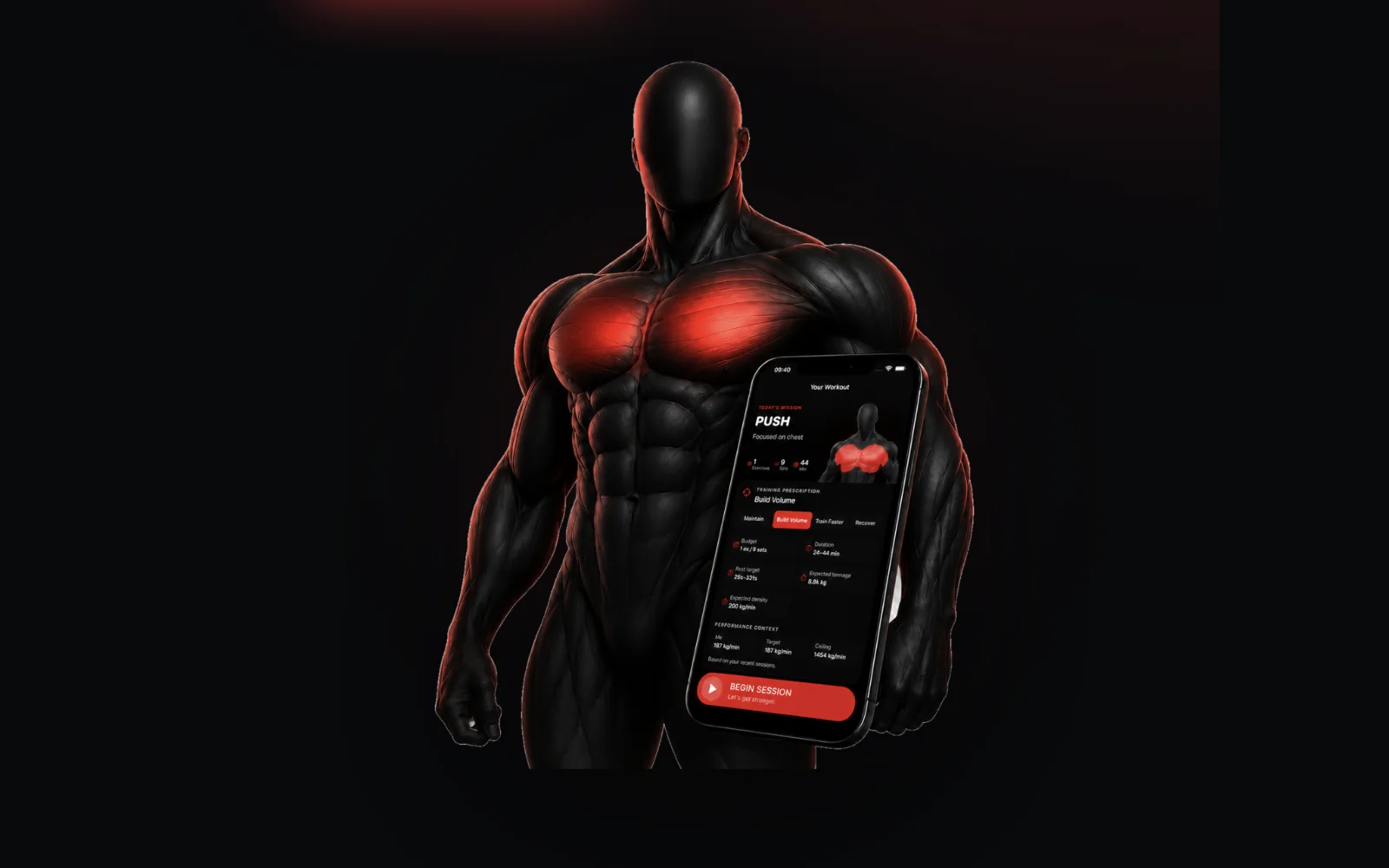
During a workout, NEX feels like a motivating companion that has you covered. You select your workout, log your sets with minimal effort, and use the built-in rest timer to know exactly how much time has passed between sets. After the workout, NEX gives you a deeper view of what happened and what it means.
The workout comes first. NEX keeps the signal visible.
The problem with workout logging
Most lifters understand why tracking is valuable. The problem is that most workout trackers ask users to do the hard work of tracking, then give them the shallowest possible answer.
Previous performance gives you a reference point. Sets and reps create a record. Load and volume show how much work you performed. Intensity can reveal whether you are challenging yourself meaningfully. History helps you identify patterns that one session cannot show.
But knowing that tracking matters does not make tracking pleasant.
The workout is a physical and mental experience. You are preparing for the next set, setting up equipment, controlling your breathing, focusing on technique, managing fatigue, and trying to stay in the zone. The more difficult the session becomes, the less appealing it is to stop and navigate a complicated interface after every set.
When logging feels slow, people stop logging. When the app feels distracting, the phone becomes part of the problem. When the experience is not intuitive, tracking starts to feel like an extra burden added to the workout.
That is the problem NEX is built to solve.
Not by removing data, but by removing friction.
The tool should adapt to the training. The training should not have to adapt to the tool.
Logging should not take you out of the zone
The best workout logger is not the one with the most controls. It is the one that lets you record what matters and get back to training.
NEX is made for the moments between sets—not for an imaginary athlete sitting at a desk after the session with unlimited time, perfect attention, and a desire to maintain a spreadsheet.
The core interaction is simple: select your workout, choose the exercise, tap in the set, and continue. The rest timer helps you keep track of the time that has passed automatically, so you do not have to estimate rest or keep checking the clock.
Logging becomes part of the rhythm of the workout rather than a separate activity happening on top of it.
You should be able to put the phone down quickly. You should be able to return to the movement without wondering whether the set was saved. You should be able to finish with a useful training record without feeling like you completed a second workout inside the first one.
This matters because consistency does not come from the most sophisticated system. It comes from a system people can continue using when they are tired, busy, distracted, or having an ordinary day.
NEX is made for ordinary days, because that is where most progress is made.
Start at your own pace
Starting is part of the problem too.
Many people begin training with a burst of motivation. They go hard, add sessions, increase volume, and try to make up for lost time. For a while, that can feel exciting. But the pace may not be sustainable. Fatigue accumulates. Motivation drops. Joints start to complain. Life interrupts the plan. Eventually, the person has to stop—not because they do not care, but because the approach was too difficult to maintain.
NEX supports a different relationship with progress.
You can start simply and train at your own pace. NEX builds a record of what that pace actually looks like. As the history grows, you can see whether you are progressing steadily, pushing harder than before, accumulating more work than you can recover from, or losing consistency.
The goal is not to make every session harder.
The goal is to help you manage your training so that you can keep going.
Consistency is not just showing up for a few intense weeks. It is creating a pattern of training that your body, mind, schedule, and life can sustain.
A single workout is not the whole story
A workout can feel productive without telling you much about the bigger picture.
You can feel strong and still be repeating the same performance. You can feel tired and still be making progress. You can have a poor session because you slept badly and mistake it for evidence that your whole program has stopped working. You can complete a high-volume workout and feel accomplished without knowing whether the extra work helped or simply added strain.
The body gives you signals in the moment, but many of the most useful signals only become visible across time.
That is why a training history matters.
Your history can show whether a movement is progressing, whether reps are improving at the same load, whether volume is accumulating, whether intensity is keeping pace, whether particular exercises are carrying most of your training, and whether your consistency is strong enough for the comparison to mean anything.
Memory is good at remembering emotional highlights. It is much worse at remembering the small, comparable details that explain change.
NEX gives your training a reliable record that becomes more useful over time.
From set logging to performance insight
NEX does not stop at “what did I do?”
That question is the foundation, but it is not the destination. Once you have enough logged workouts, the more useful questions begin:
- What changed compared with the last time I performed this movement?
- Am I improving reps, load, sets, intensity, or overall work?
- Which exercises are progressing and which ones are stalled?
- Am I doing a lot of volume without enough intensity to make it productive?
- Is my current workload building momentum or creating unnecessary fatigue?
- Is my training balanced, or am I repeatedly loading the same areas?
- Am I becoming more consistent even when no single workout feels dramatic?
NEX turns those questions into something you can investigate.
The app can bring together the signals that are usually scattered across memory, notes, and separate calculations: tonnage, volume, intensity, repetitions, sets, total weight, personal records, exercise history, and longer-term trends.
The purpose is not to produce numbers for their own sake. The purpose is to make the important pattern easier to see.
A workout log that only stores information is useful.
A workout log that helps you interpret information becomes a training tool.
One of the most valuable things a training history can do is reveal what you did not realize was happening.
You may discover that you are performing a large amount of volume, but the intensity of that work is consistently low. In that case, adding even more volume may not be the best next move (see productive volume vs junk volume). It could increase fatigue and place more strain on your joints without producing the improvement you want.
The better decision may be to prioritize intensity, improve the quality of key sets, or create more space for recovery.
You may discover that your overall weight moved is increasing while your performance on a particular exercise is flat. You may see that your consistency has improved even though your biggest lift has not yet reached a new personal record. You may notice that one movement is progressing while another has quietly stalled.
These are the kinds of insights that are difficult to find when the data is only being used for basic tracking.
NEX makes those hidden truths visible in the context of your training history.
It does not tell every lifter that the answer is more work. It does not treat every increase as progress or every flat session as failure. It gives you enough context to ask a better question.
Progressive overload with context
Progressive overload is often reduced to one instruction: add more weight.
That advice is easy to repeat. It is not always easy—or wise—to apply.
Progress can mean more load for the same number of reps. It can mean more reps with the same load. It can mean more productive sets, better control, stronger execution, improved range of motion, better consistency, or the ability to repeat a meaningful workload with less unnecessary fatigue.
The right next step depends on the movement, your goal, the phase of training, your recovery, and your response to the work. A number that goes up is not automatically proof that training is improving. A session without a new personal record is not automatically a failure.
NEX helps you see progressive overload in context. It gives you previous performance, repeated patterns, and accumulated history so that your next decision is based on more than a feeling from one day.
It does not pretend to know your body better than you do.
It gives your experience better evidence.
Your own benchmarks matter
Not every meaningful milestone has to be a new one-rep max.
Maybe you completed 1,000 repetitions in a month. Maybe you reached 10 tonnes of total volume. Maybe you trained consistently for six weeks. Maybe you performed a movement with the same workload while feeling more in control. Maybe you built enough history to understand what a productive week looks like for you.
These milestones can become personal reference points.
They help you understand what you have already achieved, what level of work feels sustainable, and what you might want to build toward next. They create motivation that is connected to your own history rather than someone else's numbers.
NEX is not designed to force every user into the same benchmark. It helps you discover your own.
The program is only as good as its feedback loop
The fitness world has no shortage of programs.
Push/pull/legs. Upper/lower. (We compared them in the best workout program.) Full body. Body-part splits. High volume. Low volume. Strength blocks. Hypertrophy blocks. Programs created by champions, coaches, researchers, influencers, and people who simply found an approach that worked for them.
Different approaches can work because different people bring different bodies, schedules, recovery capacities, preferences, training ages, and constraints to the same plan.
The program gives you structure. The feedback tells you whether that structure is working for you.
Without a useful feedback loop, it is easy to switch programs whenever progress feels slow. It is easy to add volume because more work feels productive. It is easy to change exercises before they become measurable. It is easy to mistake a difficult workout for an effective one.
With a useful feedback loop, a plateau becomes something you can investigate. You can ask whether performance has truly stopped, whether the comparison is fair, whether consistency has been high enough, whether recovery is limiting the result, or whether another signal is improving first.
NEX keeps that feedback loop visible.
Knowing when to push and when to step back
Long-term progress requires more than knowing when to work harder.
It also requires recognizing when the current pace is no longer productive.
If you have pushed consistently for six months, your next best decision may not be to add more. It may be time to deload, reduce fatigue, change the training stimulus, or use a different phase of periodization. If performance is falling while workload keeps rising, that is a signal worth understanding. If intensity is increasing but recovery is getting worse, the right response may be to manage the training rather than chase another milestone.
NEX makes these decisions more visible by showing how your current work compares with your previous patterns.
The app does not remove your judgment. It helps you use that judgment earlier and with more confidence.
The point is not to train as hard as possible forever.
The point is to train in a way that keeps you progressing toward your goals over the long term.
A companion, not a coach shouting instructions
NEX is not being built to replace experience, intuition, or professional coaching.
People can make excellent decisions from feel. Experienced lifters often develop a strong understanding of effort, readiness, technique, and recovery. That judgment matters.
But intuition has a weakness: it is difficult to preserve and compare. It can tell you how today feels. It cannot always tell you how today compares with six weeks or six months ago.
NEX sits alongside that judgment. It keeps the record, highlights the changes, and gives you a clearer basis for the decisions that remain yours.
NEX is present when it helps and invisible when it does not. It does not turn every workout into a test, every number into a command, or every decision into a notification.
The relationship is simple:
You do the training.
NEX keeps the signal visible.
What NEX is built to protect
NEX is not intended to remain a basic set logger with valuable data trapped inside it.
It is also not intended to become an overcomplicated platform that distracts users from the reason they opened it in the first place.
The workout comes first.
That means no ads pulling you out of the experience. No unnecessary distractions competing for your attention. No feature added without asking whether it helps you train, understand your performance, or make a better decision.
The purpose of NEX is not to keep you inside an app. It is to help you stay in the zone while you train, then give you enough insight to manage yourself better afterward.
The ten-year view
The goal is not for someone to use NEX for one workout cycle.
The goal is for NEX to remain useful ten years into their training.
After six months, a user should have a better connection to their performance. They should understand their pace more clearly, know what productive work looks like for them, and have more confidence deciding when to push or step back.
After several years, that history should become even more valuable. It can show how training changed across different goals, periods of consistency, plateaus, breaks, injuries, programs, and phases of life.
The record becomes a long-term relationship with your own training.
That is the product I want NEX to become: not an app that tells you what to do every day, but a companion that helps you understand yourself as an athlete over time.
Start with your next workout
NEX does not require a perfect program or a complete training history. You do not need to migrate every old notebook before you begin. You do not need to understand every metric on the first day.
Start with the next workout.
Select what you are training. Log the sets. Let the rest timer handle the time between them. Keep training. Let the picture become clearer with every session.
Over time, a set becomes a session. A session becomes a pattern. A pattern becomes a decision. A decision becomes a better way to train.
That is the promise behind NEX.
Not that data will replace experience.
Not that there is one perfect program for everyone.
Not that an app can do the work for you.
NEX gives experience a better memory, intuition better evidence, and consistent effort a visible direction.
Why NEX is worth trying
Most workout apps help you remember that you trained.
NEX helps you understand what your training is doing.
It is a fast workout logger when you are in the middle of a session. It is a detailed performance record when you want to review your work. It is a progressive-overload tracker when you are deciding what to do next. It is a way to recognize your own benchmarks, manage fatigue, and stay aligned with your goals.
And it is a long-term companion that becomes more useful as your history grows.
Start in seconds. Log without distraction. Understand your training.
NEX is now available on the App Store.
*The workout comes first. NEX keeps the signal visible.*
More from NEX Insights