Long Read10 min read
Should You Increase Weight or Reps First? The Answer Depends on What Changed
Should you add weight or repetitions first? Learn how experienced lifters progress, why both methods matter, and when you have earned the next weight.
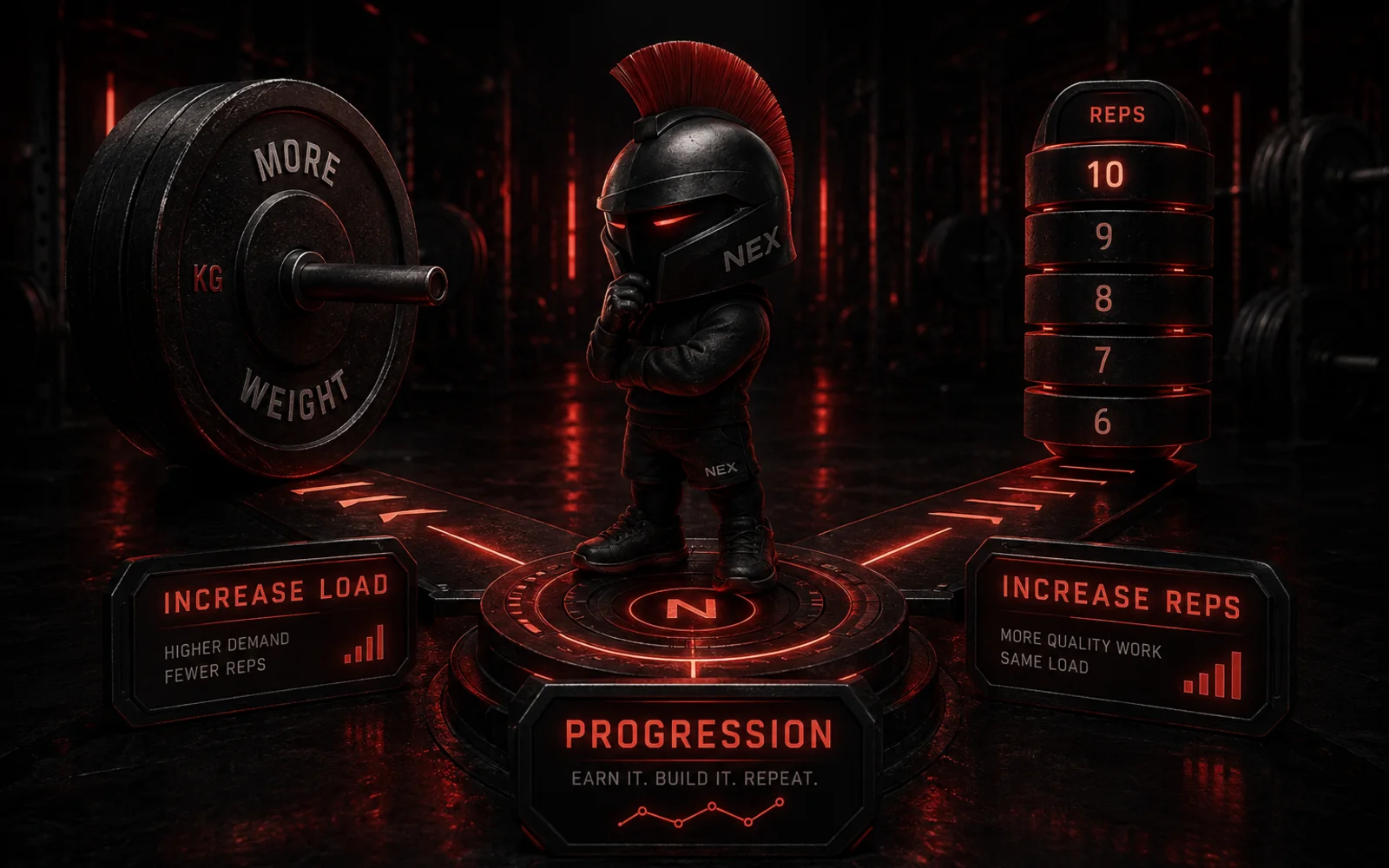
Should you add weight or repetitions first? Learn how experienced lifters progress, why both methods matter, and when you have earned the next weight.
The answer isn't choosing one over the other. It's understanding what actually changed.
Most lifters eventually reach the same moment.
You finish your last set, look at your numbers, and start thinking about next week.
Should you increase the weight?
Or should you try to squeeze out one more repetition first?
The internet loves simple answers.
"Always add weight."
"Stay in the rep range."
"Just progressively overload."
Unfortunately, real training is rarely that simple.
Because weight and repetitions aren't competing strategies.
They're two parts of the same progression system.
Why This Question Is More Complicated Than It Looks
Imagine two bench press sessions.
Session A
80 kg × 8 reps
Session B
82.5 kg × 6 reps
Which session is better?
You could argue for either.
One uses more weight.
The other completes more repetitions.
Without context, neither number tells the whole story.
And that's where many lifters get stuck.
They start chasing whichever metric feels easiest to improve instead of understanding how the metrics work together.
What Happens When You Increase the Weight?
Adding weight increases the training demand immediately.
But something usually happens in return.
Your repetitions fall.
That isn't failure.
It's expected.
Example:
80 kg × 10
↓
82.5 kg × 7
Your repetition count dropped.
Your workload changed.
Your body is adapting to a higher demand.
This is exactly how strength progression often looks.
The mistake isn't seeing fewer reps.
The mistake is expecting every number to improve at the same time.
What Happens When You Add Repetitions?
Adding repetitions keeps the load constant while increasing the amount of productive work you can perform.
That usually means:
- better technical consistency
- greater confidence with the weight
- higher work capacity
- a stronger foundation before increasing load
Example:
80 kg × 8
↓
80 kg × 9
↓
80 kg × 10
Nothing about the weight changed.
Yet the session clearly became more demanding.
You earned more work from the same load.
That is progression.
The Progression Cycle
The mistake is thinking you must choose one forever.
Most successful lifters naturally move through a cycle.
80 × 8
↓
80 × 9
↓
80 × 10
↓
82.5 × 7
↓
82.5 × 8
↓
82.5 × 9
↓
82.5 × 10
Increase repetitions.
Master the weight.
Increase the load.
Repeat.
The body doesn't care whether the improvement came from another repetition or another 2.5 kilograms.
It responds to gradually increasing demands over time.
Where Most Lifters Go Wrong
Increasing Weight Too Soon
Adding weight before the current load is under control often leads to:
- inconsistent technique
- collapsing repetition ranges
- poor confidence
- stalled progression
The weight increased.
The quality of the work didn't.
Never Increasing Weight
The opposite problem also exists.
Some lifters become comfortable adding repetitions forever without ever increasing the demand.
Eventually, the exercise drifts away from its intended training effect.
Progress requires challenge.
Not just comfort.
Changing Everything At Once
Weight.
Repetitions.
Sets.
Exercise selection.
Rest periods.
Tempo.
If all of them change together, it's difficult to understand what actually improved.
Progress becomes guesswork.
Progress Is Bigger Than One Number
Weight matters.
Repetitions matter.
But neither should become the only score.
Imagine these two workouts.
Previous Session
80 kg
8 reps
3 sets
Total tonnage:
80 × 8 × 3 = 1,920 kg
Current Session
80 kg
9 reps
3 sets
Total tonnage:
80 × 9 × 3 = 2,160 kg
The weight never changed.
Yet the total work increased significantly.
Now another example.
Previous Session
80 kg × 10
Current Session
85 kg × 8
Your total tonnage for that set is lower.
Does that automatically mean the workout was worse?
Not necessarily.
You successfully lifted a heavier weight.
Strength increased.
The numbers simply tell different parts of the story.
Tonnage Is Context—Not the Verdict
This is why total tonnage is useful.
It helps explain what happened across an entire session.
But tonnage alone doesn't decide whether progression occurred.
Higher tonnage isn't automatically better.
Lower tonnage isn't automatically worse.
The context matters.
Exercise selection.
Rep ranges.
Training goal.
Technique.
Fatigue.
Recovery.
Comparable conditions.
Every metric has strengths.
Every metric has limitations.
The goal isn't finding one perfect number.
The goal is understanding the pattern those numbers create together.
A Simple Framework
When deciding what to do next, ask yourself these questions.
1. Did I stay inside my target rep range?
If yes, continue building repetitions.
2. Have I mastered the current weight?
If the top of your rep range feels controlled and repeatable, you've probably earned the next increase.
3. Will adding weight keep the exercise productive?
If increasing load immediately destroys technique or drops you far below your intended range, wait.
4. Compare the whole session—not one set.
Look at:
- weight
- repetitions
- working sets
- total tonnage
- previous performance
The session tells a clearer story than a single lift.
At NEX, This Is the Belief Behind What We're Building
The problem isn't choosing between weight and repetitions.
The problem is losing the context around the choice.
A workout history shouldn't simply remember numbers.
It should help explain what changed.
That's why NEX keeps multiple progression signals visible together.
- Previous performance
- Weight
- Repetitions
- Personal records
- Total tonnage
Because when one number rises while another falls, the important question isn't:
"Which metric won?"
It's:
"Did my training move forward?"
The goal isn't to chase every metric.
The goal is to keep the signal visible.
The Answer
So...
Should you increase weight or repetitions first?
Usually, earn the next weight by mastering the current one.
Build repetitions.
Increase the load.
Repeat the cycle.
Most importantly, don't judge your progress from one number alone.
Weight and repetitions aren't rivals.
They're two parts of the same story.
And real progress is written across many sessions—not just one.
Related Articles
- Progressive Overload Is More Than Adding Weight: What Should You Actually Track?
- What Is Training Volume—and When Does More Stop Helping?
- How Long Should You Rest Between Sets?
- Why Am I Not Getting Stronger?
- What Is Workout Density?